Compound guide
BPC‑157 and TB‑500
These two circulate as a pair: in a year of r/Peptides, 85.7% of posts naming TB-500 also name BPC-157, and every TB-500 listing in the public test archive is a blend. A blend vial changes the arithmetic, because one draw carries both compounds at a ratio the vial fixed before you opened it. This page works that maths in the open, and lays out how little evidence sits under the stack.
Updated 30 August 2026. Forum counts computed 29 August 2026. Ledger figures captured 30 August 2026.
The pairing
Why do these two travel together?
of the 840 r/Peptides posts naming TB-500 in the trailing year also name BPC-157: 720 posts discuss them as a pair. About 200 posts a year use the Wolverine name.
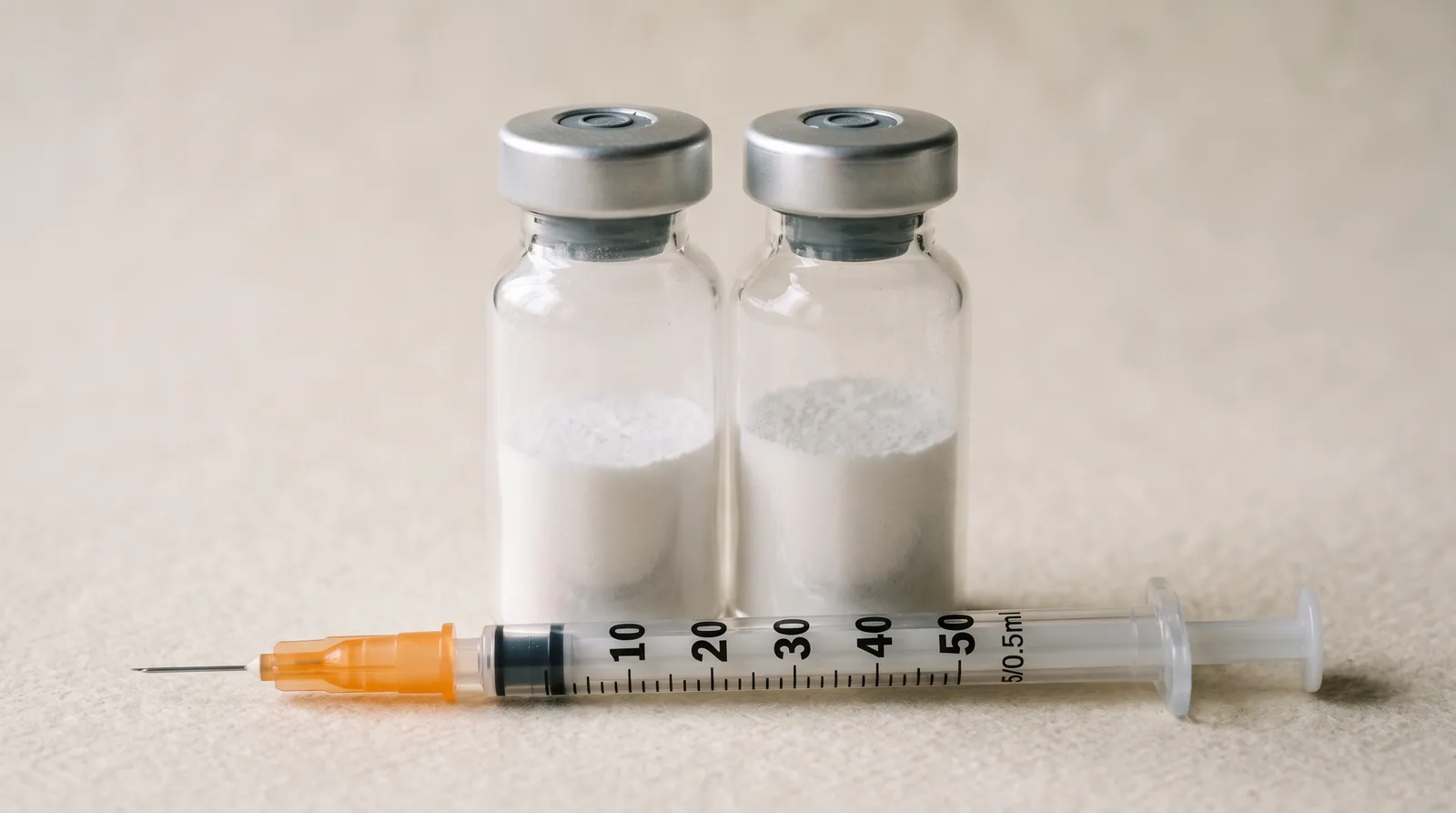
Forum lore holds that the two repair different tissue and work better together, and the market followed the lore into the vial: sellers now ship them premixed. In the accumulated Janoshik public archive, TB-500 appears in 8 listings and every one is a blend, either the two-compound mix or a four-compound KLOW-style stack with GHK-Cu and KPV. Not one solo TB-500 vial has a published test in the mirror.
The pairing has a name, the Wolverine stack, and a following. What it does not have is a clinical study. No trial has tested the combination in humans, and as the per-compound pages set out, BPC-157's human record is a 12-patient case series and TB-500's is empty. The stack's reputation rests on animal studies of each compound separately, plus repetition.
Blend arithmetic
How do you work out a dose from a blend vial?
Divide each component's labelled mass by the total water added. That gives each compound its own concentration, and they share every draw. A 10 mg BPC-157 plus 10 mg TB-500 blend in 2 mL is 5 mg/mL of each: draw 10 units and you have taken 0.5 mg of BPC-157 and 0.5 mg of TB-500, together, at the ratio the vial fixed.
| Water added | Each compound's concentration | Draw | Carries, of each |
|---|---|---|---|
| 2 mL | 5.00 mg/mL | 10 units | 0.50 mg |
| 2 mL | 5.00 mg/mL | 20 units | 1.00 mg |
| 2 mL | 5.00 mg/mL | 50 units | 2.50 mg |
| 3 mL | 3.33 mg/mL | 15 units | 0.50 mg |
| 3 mL | 3.33 mg/mL | 30 units | 1.00 mg |
Each compound's concentration is its own mass divided by the total volume; the volumes never split between components. A 10 unit draw is 0.1 mL. The equal masses make this blend easy; the method is the same when the masses differ.
The catch
Can you dose the compounds separately?
Not from one vial. The blend fixes the ratio at manufacture, so raising one compound's dose raises the other in lockstep. If a 10/10 blend's ratio suits you, the arithmetic above is all you need. If it does not, no amount of clever drawing fixes it; independent dosing takes separate vials, which is the trade the premix quietly makes for its convenience.
Multi-compound labels are where this goes wrong in practice. The most-discussed worked example in our forum year was a four-compound 80 mg blend in 3 mL, where a user could not derive one component's dose from the total. The catch is that a total-mass label cannot be split at all: you need the per-component masses from the label or the test report, and each one divides by the full 3 mL. If the label only states a total, the per-compound doses are unknowable, and that is a fact about the label, not about your arithmetic.
The evidence
What is actually known about TB-500?
human trials of TB-500, ever. The compound is the acetylated 17 to 23 fragment of thymosin beta-4, and its entire dossier is animal and in-vitro work.
TB-500 is a synthetic seven-amino-acid fragment of thymosin beta-4, the actin- binding region credited with the parent protein's wound-healing effects. It has never undergone a human trial. It surfaced first as a doping agent in racehorses, WADA prohibits it for athletes, and Australia and New Zealand schedule it as a prescription medicine with no product to prescribe.
The safety file carries one flag worth stating plainly: elevated thymosin beta-4 levels have been associated with tumour progression in some cancers, and published reviews raise the same concern for BPC-157 through its blood-vessel growth mechanism. Nobody has demonstrated either effect in a person using these compounds; nobody has run the study that could. For two peptides so often injected together, the combined human evidence is a page this short.
Questions
The stack, asked directly.
What is the Wolverine stack?+
A forum name for taking BPC-157 and TB-500 together, usually for injury recovery. It appears in about 200 r/Peptides posts a year. No clinical study has tested the combination in humans, and neither compound alone has an established human dose.
How do you calculate a dose from a blend vial?+
Divide each component's labelled mass by the total water added: that is each compound's own concentration. A 10 mg BPC-157 plus 10 mg TB-500 blend in 2 mL of bacteriostatic water is 5 mg/mL of each, so a 10 unit draw carries 0.5 mg of each compound. One draw always carries every component at the ratio the vial fixed.
Does TB-500 have human trials?+
No. TB-500, the acetylated 17 to 23 fragment of thymosin beta-4, has never undergone a human trial. WADA prohibits it for athletes, and Australia and New Zealand classify it as a prescription medicine although no product exists. Every dosing number in circulation is forum practice.
Can you dose the compounds in a blend separately?+
Not from one vial. A blend fixes the ratio at manufacture: every draw carries all components in proportion to their labelled masses. Raising one compound's dose raises the others in lockstep. Independent dosing requires separate vials.
Sources
Esposito et al. 2012: TB-500 fragment characterisation // Davison & Brown 2013: thymosin beta-4 in sport // Chi et al. 2017: thymosin beta-4 and tumour prognosis // Medsafe NZ 2025: peptide classification // WADA prohibited list // MechPeptides archive mirror
Published 29 August 2026. Forum counts are document counts over one trailing year of r/Peptides, computed 29 August 2026. Educational content; research compounds are not for human consumption.
Research use only
MechPeptides sells nothing. BPC-157 and TB-500 have no approved product anywhere, they are not dietary supplements, and nothing on this page is medical advice or a recommended protocol.
The blend arithmetic on this page converts labelled masses and volumes into concentrations and syringe readings. It assumes the label is accurate, which is exactly the assumption a test report exists to check.